
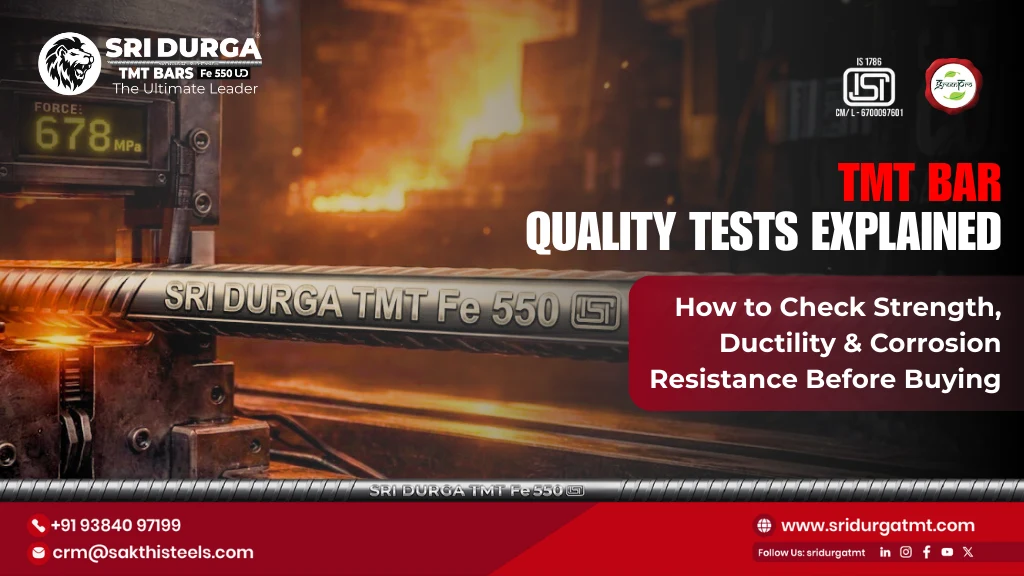
TMT Bar Quality Tests are essential for verifying the strength, ductility, and corrosion resistance of reinforcement steel before construction begins. Proper testing ensures that TMT steel bars meet safety standards and perform reliably in reinforced concrete structures. When it comes to structural safety, the quality of TMT steel bars and rebars cannot be compromised. Whether you are constructing a residential building in Chennai, an industrial unit in Coimbatore, or transporting materials to hill regions like Ooty, proper TMT bar quality testing is essential.
Builders across Tamil Nadu often ask:
- How to check TMT bar quality?
- What are the standard strength tests?
- How to identify duplicate or substandard steel and rebars?
- What is the BIS standard for TMT bars?
This guide explains the essential quality tests you must verify before purchasing construction steel.
Why TMT Bar Quality Tests Are Critical
TMT (Thermo-Mechanically Treated) bars form the backbone of reinforced concrete structures. Concrete handles compression, while steel handles tension.
If reinforcement quality fails:
- Columns weaken
- Beams crack
- Slabs deform
- Foundations lose stability
In coastal cities like Chennai, corrosion risk is high. In industrial zones like Salem and Trichy, heavy load performance is critical. In hill regions, moisture variation during transport and storage can also affect surface integrity.
That is why testing steel and rebars is non-negotiable.
BIS Standards for TMT Bar Quality Tests – IS 1786
In India, TMT bars must comply with:
- BIS (Bureau of Indian Standards)
- IS 1786 specification
IS 1786 defines:
- Yield strength
- Tensile strength
- Elongation percentage
- Bend and re-bend performance
- Chemical composition
- Rib geometry
Before you buy TMT bars in Tamil Nadu, ensure:
- BIS certification mark
- IS 1786 compliance
- Manufacturer test certificate
- GreenPro Certified production
GreenPro Certification confirms environmentally responsible manufacturing — increasingly important for sustainable and approved projects. Never purchase unmarked or uncertified steel and rebars.
Tensile Strength Test for TMT Bars
The tensile test measures how much load a bar can withstand before breaking.
For example:
- Fe 500 must have a minimum 500 MPa yield strength
- Fe 550 must have a minimum 550 MPa yield strength
Higher tensile strength ensures:
- Better load-bearing capacity
- Structural optimization
- Reduced reinforcement quantity
Among all TMT Bar Quality Tests, tensile testing is one of the most important for verifying load-bearing capacity in reinforced concrete structures. This test is crucial for multi-storey and infrastructure projects.
Bend and Re-Bend Test for TMT Bars
The bend test checks ductility and flexibility.
- The bar is bent to a specified angle.
- No cracks should appear.
Re-bend testing ensures resistance to strain aging and brittleness.
Why this matters:
- Prevents sudden failure
- Improves earthquake resistance
- Confirms ductility for seismic zones
Bend and re-bend checks are critical TMT Bar Quality Tests that help evaluate ductility and resistance to sudden structural failure. Some regions of Tamil Nadu fall under moderate seismic classification, so ductility performance is critical.
Chemical Composition Test for TMT Bars
Chemical balance directly affects performance.
Key controls include:
- Low sulfur (reduces brittleness)
- Controlled carbon (balances strength & flexibility)
- Proper manganese ratio (improves toughness)
Poor chemical composition results in:
- Brittle steel
- Welding problem
- Reduced corrosion resistance
Always request lab reports for bulk purchases.
Rib Pattern and Surface Inspection Test
The rib pattern ensures proper bonding between concrete and steel.
Check for:
- Uniform rib geometry
- Clear brand embossing
- No surface cracks
- No rust flakes
Poor rib design reduces bonding strength in reinforced concrete structures.
Weight & Diameter Accuracy
Some manufacturers reduce the diameter slightly to cut costs. Even minor reduction impacts strength and total load capacity.
Verify:
- Standard weight per meter
- Bundle weight accuracy
- Diameter tolerance as per IS 1786
Weight discrepancy is one of the most common malpractices in low-cost steel markets.
Corrosion Resistance Test for TMT Bars
In humid and coastal areas like Chennai and during transport to moisture-prone hill stations, corrosion resistance is vital.
Corrosion testing evaluates:
- Moisture endurance
- Salt exposure resistance
- Oxidation behavior
Corrosion-resistant TMT bars prevent:
- Concrete cracking
- Structural weakening
- Expensive repairs
In Tamil Nadu’s climate, this test directly affects building lifespan.
Why Contractors Trust Sri Durga TMT
Sri Durga TMT supplies steel and rebars that comply with IS 1786 standards and maintain consistent strength, weight accuracy, and corrosion resistance.
Contractors across Chennai, Coimbatore, Trichy, Madurai, Salem, and surrounding regions prefer certified supply because:
- Structural approvals require compliance
- Engineers demand test verification
- Long-term durability matters
Quality-tested steel is not optional — it is essential.
Final Checklist Before Buying
Before placing bulk orders:
- Verify BIS certification
- Check IS 1786 compliance
- Request tensile & bend test reports
- Inspect rib pattern
- Confirm weight accuracy
- Ensure corrosion suitability
- Buy from trusted suppliers
Your building’s strength depends on the steel and rebars you choose today.
Build with verification. Build with confidence