Hey contractors, builders, and site engineers, when you choose TMT bars for construction, you are not just buying steel. You are buying the result of a highly controlled manufacturing process. One of the most important parts of that process is heat treatment, which gives a TMT bar its real strength, flexibility, and long-term reliability. The significance of Heat Treatment in TMT Bars cannot be overstated for ensuring durability and performance.
If the heating process is right, the bar performs well on-site and inside concrete. If it is wrong, hidden weaknesses can remain inside the bar even if the surface looks fine.
Understanding Heat Treatment in TMT Bars helps in selecting the right materials for construction projects.
Why the Heat Treatment Process in TMT Bars Is So Important
Think of steel like cooking. Too little heat and the material stays underprocessed. Too much heat and the structure can be damaged. In the same way, the heat treatment in TMT bars process for TMT bars must be controlled very precisely to create the right balance of hardness and ductility, emphasizing the role of Heat Treatment in TMT Bars in achieving this balance.
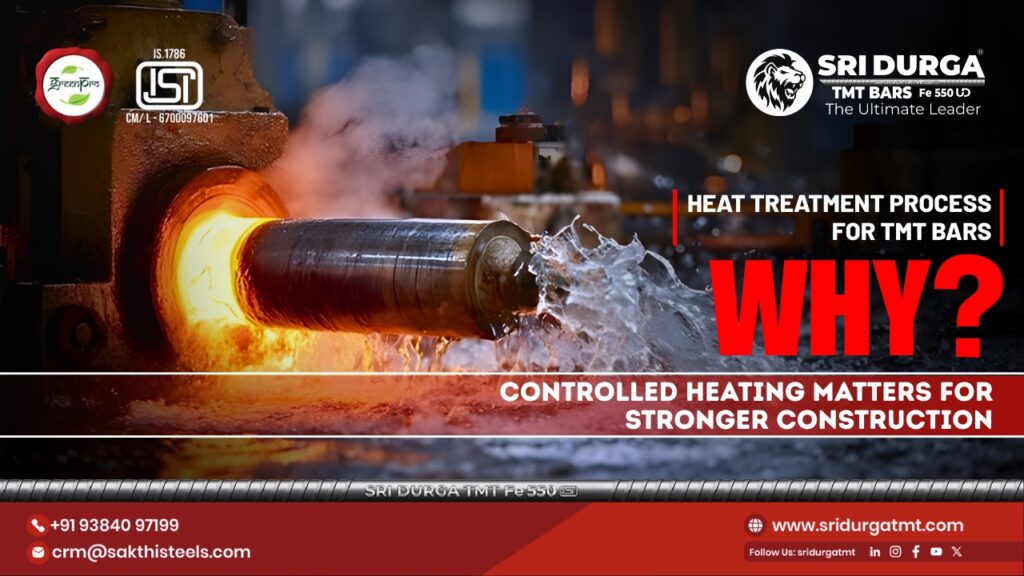
Heat treatment in TMT bars plays a crucial role in modern manufacturing, where steel billets are reheated to around 1200°C to 1250°C, rolled into bars, and then rapidly water-quenched. After quenching, the bar undergoes self-tempering and atmospheric cooling, creating a hard outer layer and a softer, ductile core. This is what gives TMT bars their unique combination of high strength and bendability.
The Science Behind Strong TMT Bars
When a red-hot TMT bar exits the rolling mill, it passes through a quenching box where pressurized water cools the outer surface instantly. This forms a hardened outer structure. At the same time, the inner core remains hot for a short period, and the heat from that core tempers the outer layer. The final bar develops a composite structure with a strong outer rim and a tough, flexible inner core. That balance is what makes high strength TMT bars suitable for modern RCC construction. Source Source
Why Strength Alone Is Not Enough
Many buyers focus only on strength, but the best TMT bars for construction need more than strength. They also need ductility. A bar that is strong but brittle can fail under stress. A bar that combines strength with flexibility performs better under heavy loads, bending requirements, and seismic stress.
That is why the quenching and self-tempering process is so important. The hardened outer layer contributes to yield strength, while the ferrite-pearlite core improves ductility and toughness. This combination makes TMT bars safer and more dependable in buildings, bridges, and infrastructure. Source
What Happens When Heating Is Not Controlled Properly
If the heat treatment in TMT bars process is inconsistent, the bar may develop performance issues such as:
- Poor Surface Hardening
- Brittle Core Structure
- Uneven Strength Distribution
- Lower Ductility
- Reduced Reliability Under Load
Even a small error in furnace temperature, rolling temperature, or quenching intensity can affect the final microstructure of the bar. That is why heat treatment in TMT bars must be carefully controlled, and builders and contractors should always choose a quality TMT bar manufacturer that follows strict process standards.
Why Process Control Matters in Real Construction
On-site performance depends on what happens inside the bar during manufacturing. A properly heat-treated TMT bar supports:
- Better load-Bearing Strength
- Safer Bending and Fabrication
- Improved crack resistance
- stronger bonding in RCC structures
- longer service life in demanding environments
For anyone searching for the best TMT bars for house construction or large structural work, manufacturing discipline matters as much as raw material quality.
How Sri Durga TMT Adds Confidence to Every Project
At Sri Durga TMT, heat treatment in TMT bars is not treated as a routine step it is part of a carefully managed production system. The company highlights advanced manufacturing, controlled melting, billet production through CCM, hot rolling, pressurized-water quenching, cooling bed processing, and quality testing at every stage. Sri Durga also positions its bars around superior strength, flexibility, corrosion resistance, and earthquake resilience, with official emphasis on Tempcore technology and strict quality assurance. Source Source Source
Final Thoughts
The real quality of a TMT bar is not decided by appearance alone. It is built through the perfect heat treatment process, where reheating, rolling, quenching, self-tempering, and cooling must all work together. When these stages are controlled properly, the result is a bar that offers the strength, flexibility, and durability modern construction demands.
If you are looking for FE550 TMT bars and a trusted manufacturing process backed by quality control, Sri Durga TMT stands out as a brand focused on engineering reliable strength for real construction performance.