
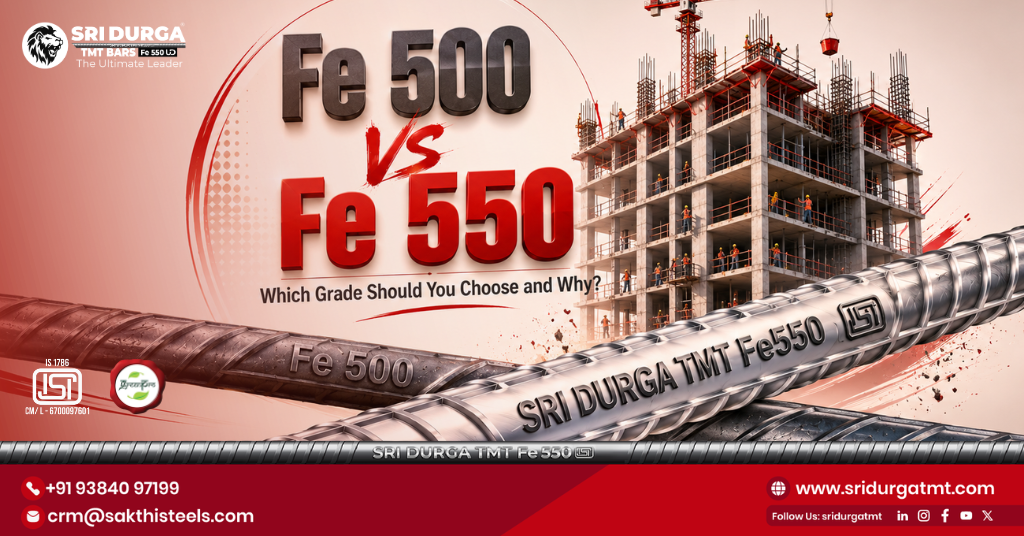
Fe 500 vs Fe 550 is one of the most common comparisons builders, contractors, and homeowners make before buying steel for construction projects in Tamil Nadu. Choosing between Fe 500 vs Fe 550 TMT bars affects structural strength, corrosion resistance, steel consumption, and long-term project cost.
Walk into any steel dealer in Tamil Nadu and ask for TMT bars the first question they will ask you is: which grade? Fe 500 or Fe 550? For many buyers, this is where the confusion begins. Both are high-strength TMT bars. Both carry BIS certification. Both are widely used across South India. So what is the real difference between Fe 500 vs Fe 550, and which one is the smarter choice for your project in 2026?
This guide explains Fe 500 vs Fe 550 in simple terms including strength, ductility, corrosion resistance, pricing, and where each grade performs best.
What Does the Grade Number Actually Mean?
Before comparing the two grades, it helps to understand what the number stands for.
In TMT bar grading, Fe refers to iron-based steel and the number represents the minimum yield strength in megapascals (MPa). Yield strength is the amount of stress a bar can handle before it permanently deforms.
So:
- Fe 500 — minimum yield strength of 500 MPa
- Fe 550 — minimum yield strength of 550 MPa
This means an Fe 550 bar can handle 10 percent more stress than an Fe 500 bar before it begins to permanently bend. In structural terms, that difference is significant especially in multi-storey buildings, heavy load applications, and areas with seismic or coastal exposure.
Both grades are manufactured under IS 1786 standards set by the Bureau of Indian Standards and go through the same thermo-mechanical treatment process rapid quenching, self-tempering, and atmospheric cooling to achieve their respective strength levels.
Fe 500 vs Fe 550 TMT Bar – Key Differences at a Glance
| Property | Fe 500 | Fe 550 |
| Minimum Yield Strength | 500 MPa | 550 MPa |
| Minimum Tensile Strength | 545 MPa | 585 MPa |
| Minimum Elongation | 12% | 10% |
| Corrosion Resistance | Good | Better |
| Best For | Low to mid-rise residential | Multi-storey, commercial, infrastructure |
| Steel Consumption | Slightly higher quantity needed | Optimised — less steel required |
| Cost Per Tonne | Lower | Slightly higher |
| Total Project Cost | Can be higher due to more steel | Often lower due to optimised design |
Strength – How Big Is the Difference?
On paper, the difference between Fe 500 and Fe 550 is 50 MPa. That may not sound dramatic, but in structural engineering it translates to a meaningful improvement in load-bearing efficiency.
An Fe 550 bar allows engineers to design slimmer columns, longer beam spans, and optimised slab reinforcement without compromising on the safety margins required by structural codes. This is why Fe 550 has become the preferred grade for modern construction across Tamil Nadu it delivers more structural performance per kilogram of steel used.
For a single-storey home, this difference may be minor. But for a three-storey apartment, a commercial building, or an infrastructure project, the cumulative impact on both structural safety and total steel consumption is significant.
Ductility – Which Grade Bends Better?
Ductility refers to how much a bar can stretch or bend before breaking. This is a critical property for earthquake resistance and on-site fabrication.
Fe 500 offers a minimum elongation of 12 percent, while Fe 550 offers 10 percent. This means Fe 500 is marginally more ductile in standard form. However, there is also a variant called Fe 550D the D stands for ductility which combines the high strength of Fe 550 with enhanced elongation properties, making it ideal for seismic zones and large infrastructure projects.
For most construction in Tamil Nadu, standard Fe 550 provides adequate ductility for residential and commercial applications. For projects in seismic-sensitive zones or large public infrastructure, Fe 550D is worth considering.
Corrosion Resistance – Which Performs Better in Tamil Nadu’s Climate?
Tamil Nadu presents a demanding environment for steel coastal humidity in Chennai, high heat in interior regions, monsoon moisture cycles, and industrial pollution in cities like Trichy and Salem. In all these conditions, corrosion resistance is not optional.
Fe 550 bars are manufactured with tighter chemical composition control lower sulphur, lower phosphorus, and balanced carbon content compared to Fe 500. This gives Fe 550 a slight edge in resisting oxidation and surface corrosion over time.
For projects near the coast, in flood-prone zones, or in high-humidity areas, choosing Fe 550 is a practical long-term decision that reduces the risk of structural corrosion and expensive future repairs.
To understand more about how to evaluate TMT bar quality before purchase, read our complete guide on How to Identify Fake or Low-Quality TMT Steel.
Total Project Cost – Which Grade is Actually Cheaper?
This is where most buyers get the calculation wrong.
Fe 500 costs slightly less per tonne than Fe 550. So many buyers assume Fe 500 automatically saves money. But the real cost comparison looks at total steel consumption, not just price per tonne.
Because Fe 550 offers higher yield strength, structural engineers can reduce the number of bars used per column, beam, and slab without compromising the design. Across a full building, this typically reduces total steel consumption by 5 to 10 percent.
Here is what that means in practice:
- Fewer bars to purchase, transport, and store
- Less cutting, bending, and tying labour
- Reduced congestion in reinforcement, allowing better concrete flow
- Lighter structural dead load, which can reduce foundation size and cost
When all these factors are added up, Fe 550 often results in a lower total project cost than Fe 500, especially for buildings above two storeys.
Before finalising your grade choice, calculate your exact steel requirement for both grades using the Sri Durga TMT Calculator it gives you instant weight and quantity estimates so you can compare total consumption across grades before committing to a purchase.
When Should You Choose Fe 500?
Fe 500 is a solid, reliable grade for projects where:
- The structure is a single or double-storey residential building
- Load requirements are light to moderate
- The site is not in a coastal or high-humidity zone
- Budget constraints require a lower per-tonne rate
- The structural engineer specifies Fe 500 in the design
For small homes, boundary walls, and low-rise residential projects in interior Tamil Nadu, Fe 500 is a practical and cost-effective choice.
When Should You Choose Fe 550?
Fe 550 is the stronger recommendation for projects where:
- The building is three storeys or above
- The structure is a commercial complex, warehouse, hospital, or institution
- The site is in coastal Tamil Nadu or a high-humidity zone
- Infrastructure applications like bridges, flyovers, or water tanks are involved
- The structural engineer wants to optimise reinforcement design and reduce total steel quantity
- Long-term durability and minimal maintenance are priorities
For most modern construction in Tamil Nadu in 2026 from mid-rise apartments in Chennai to commercial complexes in Coimbatore Fe 550 is the smarter grade choice.
What the Standards Say
According to BIS IS 1786 specifications, both Fe 500 and Fe 550 are recognised grades for high-strength deformed steel bars used in reinforced concrete construction. The standard defines minimum requirements for yield strength, tensile strength, elongation, bend and re-bend performance, and chemical composition for each grade.
Always ensure the bars you purchase carry clear BIS certification markings and are supplied with manufacturer test certificates confirming compliance with IS 1786.
Why Sri Durga TMT Recommends Fe 550 for Tamil Nadu Construction
Sri Durga TMT manufactures Fe 550 grade TMT bars as its primary product, and that is a deliberate choice based on what Tamil Nadu’s construction environment demands. In the comparison of Fe 500 vs Fe 550, Fe 550 offers higher strength, better corrosion resistance, and improved structural efficiency for modern projects. The combination of coastal exposure, high seasonal humidity, growing infrastructure requirements, and the shift towards multi-storey residential and commercial development makes Fe 550 the most appropriate grade for the majority of projects in the region.
When builders compare Fe 500 vs Fe 550, they often look at long-term durability, steel consumption, and overall project performance. For medium and large construction projects, Fe 500 vs Fe 550 is no longer just a price comparison it is a decision about structural reliability and future maintenance costs.
Every Sri Durga Fe 550 bar is manufactured using Tempcore technology, controlled billet production through CCM, pressurised water quenching, and rigorous quality testing ensuring consistent strength, accurate weight, and long-term corrosion resistance across every batch. This is one reason why many engineers prefer Fe 500 vs Fe 550 comparisons before finalising reinforcement steel for apartments, commercial complexes, and infrastructure work.
With BIS certification and GreenPro certified manufacturing, Sri Durga Fe 550 TMT bars give builders and contractors across Chennai, Coimbatore, Trichy, Madurai, and Salem the structural confidence their projects demand. For projects where Fe 500 vs Fe 550 becomes a critical structural decision, Sri Durga Fe 550 delivers the strength and consistency required for modern construction in Tamil Nadu.
Conclusion
The choice between Fe 500 and Fe 550 comes down to your project type, location, load requirements, and long-term goals. Fe 500 works well for light residential construction. Fe 550 delivers better strength, better corrosion resistance, and often lower total project cost for medium to large construction.
In Tamil Nadu’s demanding construction environment in 2026, Fe 550 is not just the stronger option it is the smarter one. Always consult your structural engineer, verify certifications, and choose a manufacturer who delivers consistent quality from billet to bar.