
Hey contractors and construction professionals, most people see only the finished TMT bar. But the real story begins much earlier. The strength, durability, and performance of a bar depend on every stage of the TMT bar manufacturing process, starting from raw material preparation and ending with controlled quenching.
If you want to choose the best TMT bars for construction, it helps to understand how TMT bars are made and why every stage matters.
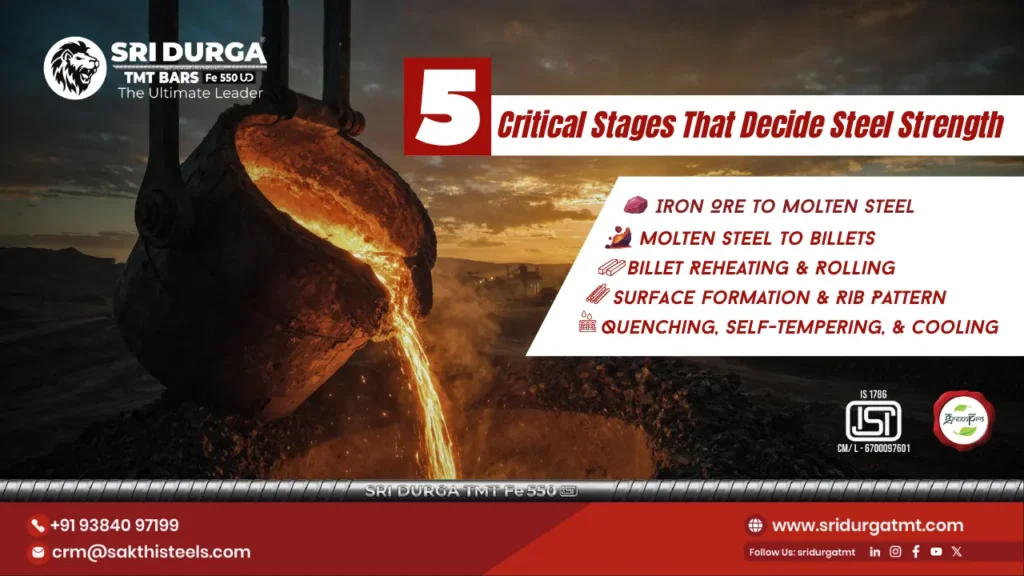
Stage 1: Iron Ore to Molten Steel
The process starts with iron ore and other raw materials, which are processed and heated to produce molten iron and then refined into steel. During this stage, impurities are removed, and the chemical composition is controlled. Better purification at the beginning means better consistency in the final steel. Source
If this stage is poorly controlled, unwanted impurities can remain in the steel and later reduce strength, durability, and structural reliability.
Stage 2: Molten Steel to Billets
Once the molten steel is refined, it is cast into semi-finished forms such as billets using continuous casting systems. Billets are the raw material for rolling TMT bars, so their internal consistency is critical. Proper casting helps reduce defects, control shape, and create a more uniform structure for later processing. Source Source
If casting is not handled well, internal cracks, uneven solidification, or composition issues can affect the quality of the finished bar.
Stage 3: Billet Reheating and Rolling
In the next step, billets are reheated to about 1200°C to 1250°C and passed through rolling mills to transform them into the final bar size and shape. This stage is important because controlled reheating and rolling improve grain flow, bar dimensions, and overall mechanical consistency. Source
When reheating or rolling is uneven, the result may be inconsistent diameter, reduced performance, and non-uniform strength across the bar.
Stage 4: Surface Formation and Rib Pattern
As the bars are rolled into final form, ribs are created on the surface. These ribs are not just visual features — they help the steel bond effectively with concrete. Strong rib design improves grip, load transfer, and the overall stability of reinforced concrete structures.
For builders searching for TMT bars for house construction or commercial work, good rib formation is essential because poor bonding can affect structural performance over time.
Stage 5: Quenching, Self-Tempering, and Cooling
This is the most critical stage in the TMT steel manufacturing process. After rolling, the hot bar enters a quenching box where water rapidly cools the surface. Then the remaining heat in the core tempers the outer layer. Finally, atmospheric cooling stabilizes the bar. This controlled process creates a strong outer rim and a ductile inner core, giving the bar the right mix of tensile strength and flexibility. Source Source
If quenching is too aggressive, the bar can become brittle. If it is too weak, the outer layer may not harden enough. Either way, site performance is affected.
Why These 5 Stages of TMT Bars Matter to Buyers
TMT bars may look similar from the outside, but their real quality is decided inside the manufacturing line. Every stage affects the final result:
- Raw material quality affects purity
- Billet quality affects consistency
- Reheating affects grain structure
- Rolling affects shape and size
- Quenching affects strength and ductility
That is why choosing a trusted manufacturer matters as much as choosing the right grade.
Why Sri Durga TMT Bars Is a Strong Brand Story for This Topic
Sri Durga TMT already has a strong manufacturing narrative that fits perfectly with this blog. On its official site, the brand highlights DRI sponge iron usage, induction-furnace melting at around 1650 degrees, billet manufacturing through CCM, hot rolling, pressurized-water quenching, cooling-bed processing, and quality testing before dispatch. The company also promotes superior strength, corrosion resistance, earthquake resilience, and consistent quality through controlled production.
Final Thoughts
The journey from iron ore to TMT bar is not just a factory process; it is the foundation of structural safety. A mistake in any one stage can affect durability, bonding, flexibility, and long-term performance.
If you want quality TMT bars for builders and contractors, it makes sense to choose a brand that focuses on every manufacturing stage, not just the finished product. Sri Durga TMT positions itself around exactly that promise: quality control, engineered strength, and reliable performance where it matters most on site