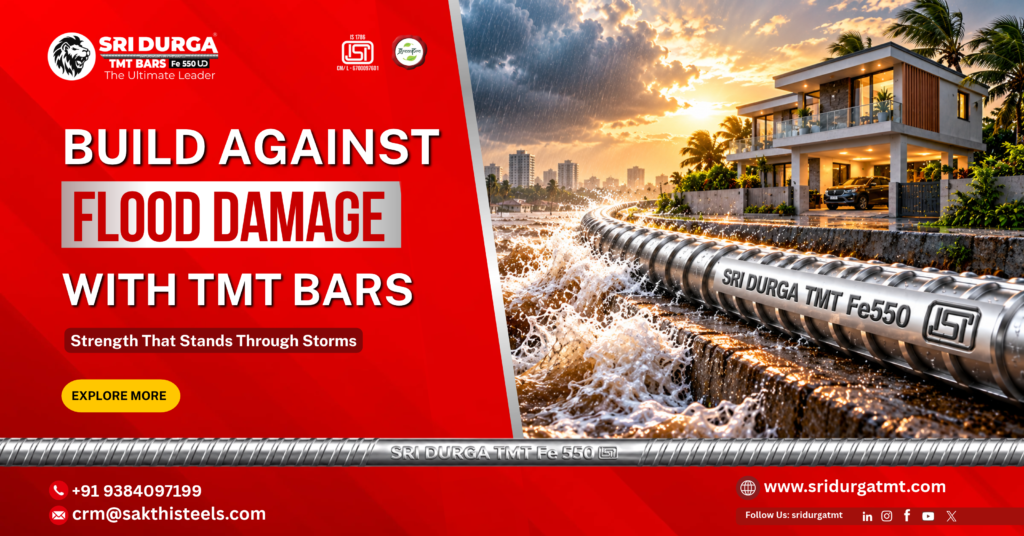
Flood-resistant house construction in Chennai comes down to five things: choose and test the site, raise the plinth above the highest known flood level, design the right foundation for the soil, use strong, ductile TMT steel with proper concrete cover, and plan drainage and electricals for water.
Steel is the backbone of all five. Sri Durga TMT, India’s No.1 Green Steel TMT, is 5-star certified by the Ministry of Steel with 91.36% greenness, and its Fe 550 bars are made right next door in Kancheepuram for Chennai’s soil and rain.
Why Chennai Homes Need Flood-Resistant Design
Chennai is flat, coastal and full of old lakes and marshlands. Many newer areas, such as parts of Velachery, Pallikaranai, Madipakkam, Tambaram, Mudichur and Perumbakkam, are low-lying and have flooded in recent years.
During the Northeast Monsoon (October–December), heavy rain and cyclones can cause:
- Water entering the ground floor
- Weak, waterlogged soil under the foundation
- Long periods of dampness that attack concrete and steel
A flood-resistant house doesn’t stop rain. It keeps water out of the living area and keeps the structure strong when water does come.
Step 1: Check the Site Before You Buy or Build
- Ask neighbours how high the water reached in 2015 and 2023
- Check the road level. Roads are often raised over the years, leaving older plots below road level
- Avoid plots inside old lake beds or next to stormwater channels, if possible
- Check approvals and local rules with CMDA or your local body
- Do a soil test. Chennai has soft clay in many areas, which needs special foundation design
Step 2: Plinth Height for a House in Chennai
The plinth is the base level of the house, the floor of the ground floor.
- Keep the plinth above the highest flood level seen on your street, plus a safety margin
- Also keep it well above the current road level, since roads keep rising
- In flood-prone areas, many engineers suggest stilt parking, with living spaces on the first floor
- Use a plinth beam with proper TMT reinforcement to tie the columns together at the base
Your structural engineer will fix the exact plinth height for your plot. Don’t decide it on guesswork.
Step 3: Best Foundation for a Flood-Prone Area
| Soil Condition | Common Foundation Choice |
| Firm soil, low flood risk | Isolated footings with plinth beam |
| Soft clay / waterlogged soil | Raft foundation or combined footings |
| Very weak soil / marshland | Pile foundation |
Tips:
- Follow the soil test report. Never copy your neighbour’s foundation
- Add a damp-proof course (DPC) at plinth level to stop water rising into the walls
- Backfill and compact around the foundation properly so water doesn’t collect
Step 4: TMT Steel for Flood-Resistant Construction
The foundation, columns, plinth beam and slabs all depend on steel. In wet, flood-prone ground, the steel must be strong, ductile and well protected.
What to use:
- Fe 550 TMT bars: higher strength than Fe 500 (see our Fe 500 vs Fe 550 guide)
- Good elongation (ductility): the bars bend instead of snapping when soil settles
- BIS / IS 1786 certified bars only
How to use it:
- Follow the bar sizes and spacing in your structural drawing
- Use cover blocks everywhere. Wet ground needs proper concrete cover, so ask your engineer for the right cover for your site
- Store bars correctly before use. See our monsoon rust protection guide
- Don’t cut or skip column bars to save cost. Columns carry the whole house in a flood
How much steel? See our guide on steel required for a 1200 sq ft house.
Step 5: Drainage, Sump, Septic and Electricals
- Drainage: slope the yard away from the house; keep stormwater drains clear before the monsoon
- Rainwater harvesting: it’s mandatory in Tamil Nadu and helps reduce surface water
- Sump: seal the lid and raise its top above flood level so drain water can’t get in
- Septic tank: use a sealed lid and a non-return valve on the outlet pipe
- Electricals: keep switchboards, the meter and the inverter higher on the ground floor
- Waterproofing: waterproof the plinth, the terrace and the sunshades
Flood-Resistant House Checklist for Chennai
- Flood history of the street checked (2015 / 2023)
- Soil test done
- Plinth above highest flood level + margin
- Foundation designed by a structural engineer
- Fe 550 BIS-certified TMT bars
- Cover blocks used in all members
- DPC and waterproofing at plinth
- Sump, septic and electricals flood-safe
- Rainwater harvesting in place
Best TMT Bars for House Construction in Chennai
For a flood-resistant home, choose steel that is strong, ductile and fresh from a nearby plant. Sri Durga Fe 550 TMT bars offer:
- 570 N/mm² yield strength, 630 N/mm² tensile strength, 16% elongation
- Carbon 0.25% max, good for welding and bending
- BIS certified to IS 1786
- 5-star green steel: 91.36% greenness, 0.19 t CO₂. Learn more in our Green Steel Star Rating guide
- Made in Kancheepuram, close to Chennai, so bars reach your site fresh, with less time in the rain
- Sizes 8mm to 32mm, from footing to slab
That’s why Sri Durga is among the best TMT bars in Chennai and the top TMT brands trusted by builders in Velachery, Tambaram, OMR, ECR, Chengalpattu, Kanchipuram and Tiruvallur. See our 5-star green steel TMT bars.
Planning a flood-safe home? Find a Sri Durga dealer near you or contact us for today’s price.
Build strong. Build green. Build with Sri Durga TMT. 📞 +91 93840 97199 | 📧 crm@sakthisteels.com
Frequently Asked Questions
How do I build a flood-resistant house in Chennai?
Check the flood history of the site, do a soil test, raise the plinth above the highest flood level, design the foundation for the soil, and use Fe 550 BIS-certified TMT bars with proper concrete cover.
What should be the plinth height for a house in Chennai?
It should be above the highest flood level seen on your street, with a safety margin, and well above the current road level. Your structural engineer will fix the exact height.
What is the best foundation for a flood-prone area?
It depends on the soil test. Firm soil may use isolated footings; soft clay often needs a raft foundation; very weak or marshy soil may need piles.
Which TMT bar is best for flood-prone areas in Chennai?
Fe 550 TMT bars with good elongation and BIS certification. Sri Durga Fe 550 TMT bars are made in Kancheepuram and are 5-star green steel certified.
Is stilt parking good for flood-prone areas?
Yes. Stilt parking keeps living areas on the first floor, away from floodwater. The stilt columns must be designed and reinforced properly.
Which are the top TMT brands in Chennai for house construction?
Builders look for BIS-certified Fe 550 bars from a trusted local plant. Sri Durga TMT is among the top TMT brands in Chennai, with 5-star green steel certification.